Most outsourcing stories are about speed: how fast a vendor can staff a project. Speed matters, but it is not what creates the most value. In our experience, the biggest returns come from teams that stay.
Three of our engagements show it well:
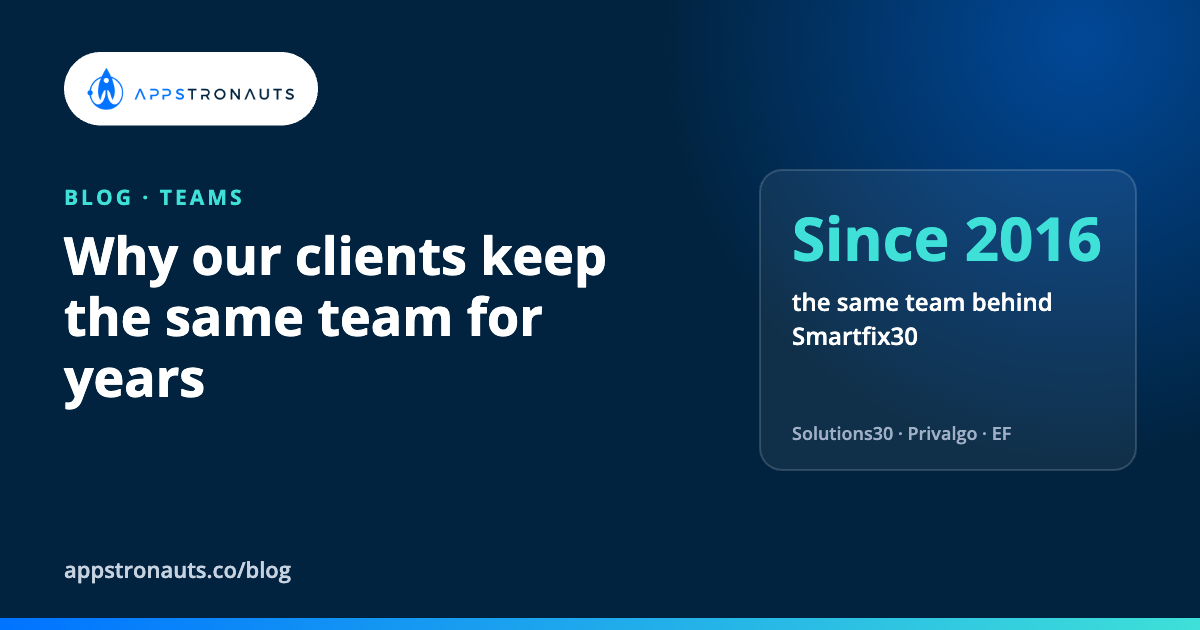
- Solutions30: the same team has built and run the Smartfix30 field service platform since 2016, from the first MVP to more than 3.1 million users and over 11,000 technicians using it every day. Today it is a team of 4.
- Privalgo: 3 of our engineers have worked inside the client’s team on a business-critical Dynamics 365 CRM for 2.5 years, and the work is still going.
- EF Education First: for a year, a team of 3 modernised EF Studio, a platform used by more than 20,000 people, and shipped a new release every month.
Here is what these teams have in common.
1. Knowledge compounds
In the first months, any team is learning: the codebase, the business, the people, the decisions made years ago and why. That learning is expensive, and it is lost every time someone leaves.
A team that stays turns that knowledge into speed. On Smartfix30, the people who designed the first version are the same people who now decide how to scale it. They do not need a document to know why something was built a certain way.
2. Small and senior beats large and junior
None of these teams is big: 3 or 4 people. That is a deliberate choice. A boutique team of experienced engineers makes decisions, owns the result and does not need a layer of management to coordinate it.
On Privalgo, three people took a Dynamics 365 environment that was fragile and hard to change, cleaned it up from 159 unmanaged solution components to 7 managed ones, and kept production running the whole time.
3. A steady rhythm
Long-term teams work in a predictable rhythm. For EF Studio, that meant two sprints a month and a new product release every month, for a whole year, while the platform was being moved to newer technology and new services were being explored.
A rhythm like this builds trust on both sides. The client knows what to expect and when, and the team gets feedback early instead of at the end.
4. Continuity is the vendor’s job
People go on holiday, get sick, and sometimes change jobs. In a good long-term engagement, the client barely notices. That is our responsibility, not theirs: we plan handovers, keep knowledge shared inside the team and make sure the sprint does not stop.
5. The team works inside the client’s team
In all three cases our engineers worked in the client’s process: their stand-ups, their backlog, their tools. We meet clients regularly, in person too. The best compliment we get is when a client forgets which people are “external”.
When a long-term team makes sense
- You have a product that will keep evolving for years, not a one-off project.
- The system is business-critical and knowledge of it is hard to replace.
- You want to grow capacity without growing headcount and management overhead.
Most of our clients start small, often with one or two engineers through Team Extension, and grow from there. Some hand us a whole product through a Dedicated Team. Either way, the goal is the same: a team you will want to keep.
Read the full stories: Smartfix30, Privalgo and EF Education First.

Appstronauts
Need senior .NET, JavaScript or Dynamics 365 engineers on your team?
Book 30 minutes with Rado, our co-founder. Tell us what your team needs and get a straight answer on whether we can help.
Book a call with Rado How team extension works →