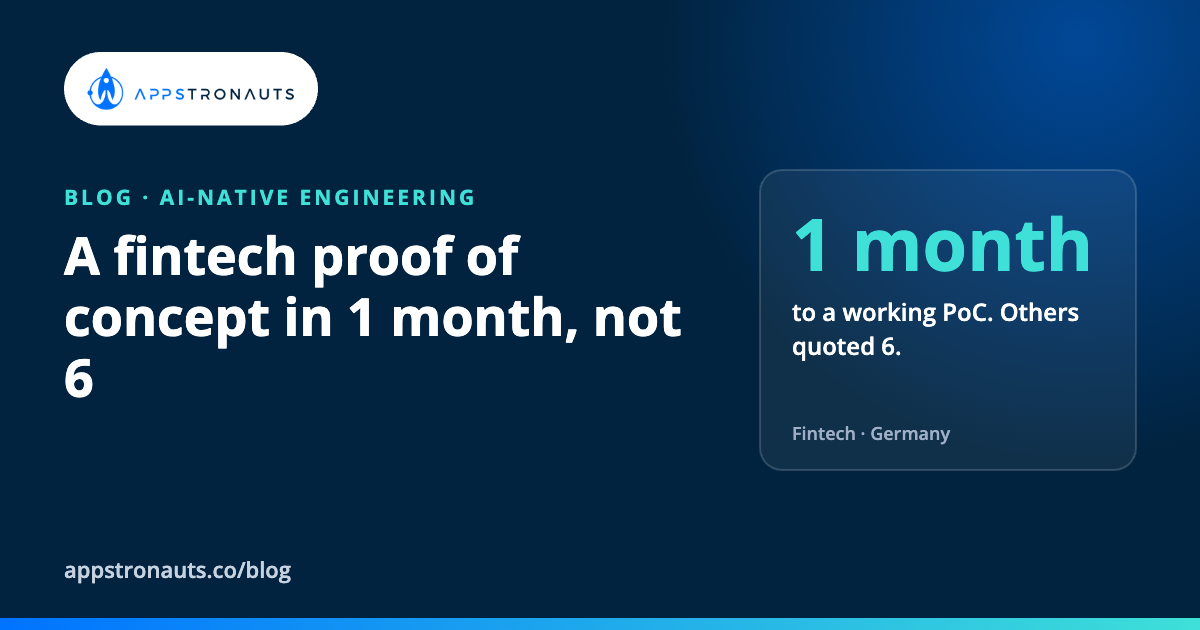
A fintech client from Germany came to us with a new product idea. Before talking to us, they had asked other software companies for a quote. The answers were consistent: around six months to build a proof of concept.
We delivered a working proof of concept in one month. Two months later, the client was already making money from it.
This was not a trick, and nobody worked through the night. It is what happens when a senior team builds with AI from the first day. Here is what changes, and what does not.
Why the gap was so big
A six-month estimate for a proof of concept usually comes from a traditional plan: long analysis up front, a full specification, then development of everything that might be needed. Each step is reasonable on its own. Together they push the moment when the business can test the idea far into the future.
A proof of concept has one job: to show, as early as possible, whether the idea works. Everything that does not serve that job can wait.
What AI-native engineering changes
Our engineers work with tools like Claude and Cursor in practically every project. Across our work, that roughly doubles their output and shortens delivery by up to 40%, with the same savings on cost. On a proof of concept the effect is even stronger, because so much of the work is exactly what AI tools are good at:
- Scaffolding and boilerplate that used to take days now takes hours.
- Trying alternatives is cheap. We can build two versions of a feature and keep the better one, instead of debating it in a meeting.
- Rewriting is no longer scary. When the first version teaches you something, changing direction costs far less than it used to.
- Documentation and tests are written alongside the code, not postponed.
What does not change
AI makes a good team faster. It does not make a weak team good. A few things stayed firmly in human hands:
- Deciding what to build. Cutting a six-month plan down to one month is a product decision, not a coding trick. We agreed with the client on the smallest version that could prove the business case.
- Architecture. Senior engineers decided how the system was built, so the proof of concept could grow into a product instead of being thrown away.
- Review. Every change generated with AI was reviewed by an experienced engineer before it was merged.
- Security. In fintech this is not negotiable. We agree up front which tools and models can be used, what data they can see, and keep code and data within the client’s security rules.
From proof of concept to revenue
The most important number in this story is not one month. It is the two months after that. Because the proof of concept was built on solid foundations, the client did not have to start again. They put it in front of customers, learned quickly, and it started earning money.
That is the real value of speed: not a faster demo, but an earlier answer to the only question that matters, which is whether the business works.
Is your idea waiting for a six-month project?
If you have an idea you want to validate, start with one use case, one month and a clear way to measure success. Read more about how we work on our AI Development page, or book a call and tell us what you want to test.

Appstronauts
Need senior .NET, JavaScript or Dynamics 365 engineers on your team?
Book 30 minutes with Rado, our co-founder. Tell us what your team needs and get a straight answer on whether we can help.
Book a call with Rado How team extension works →